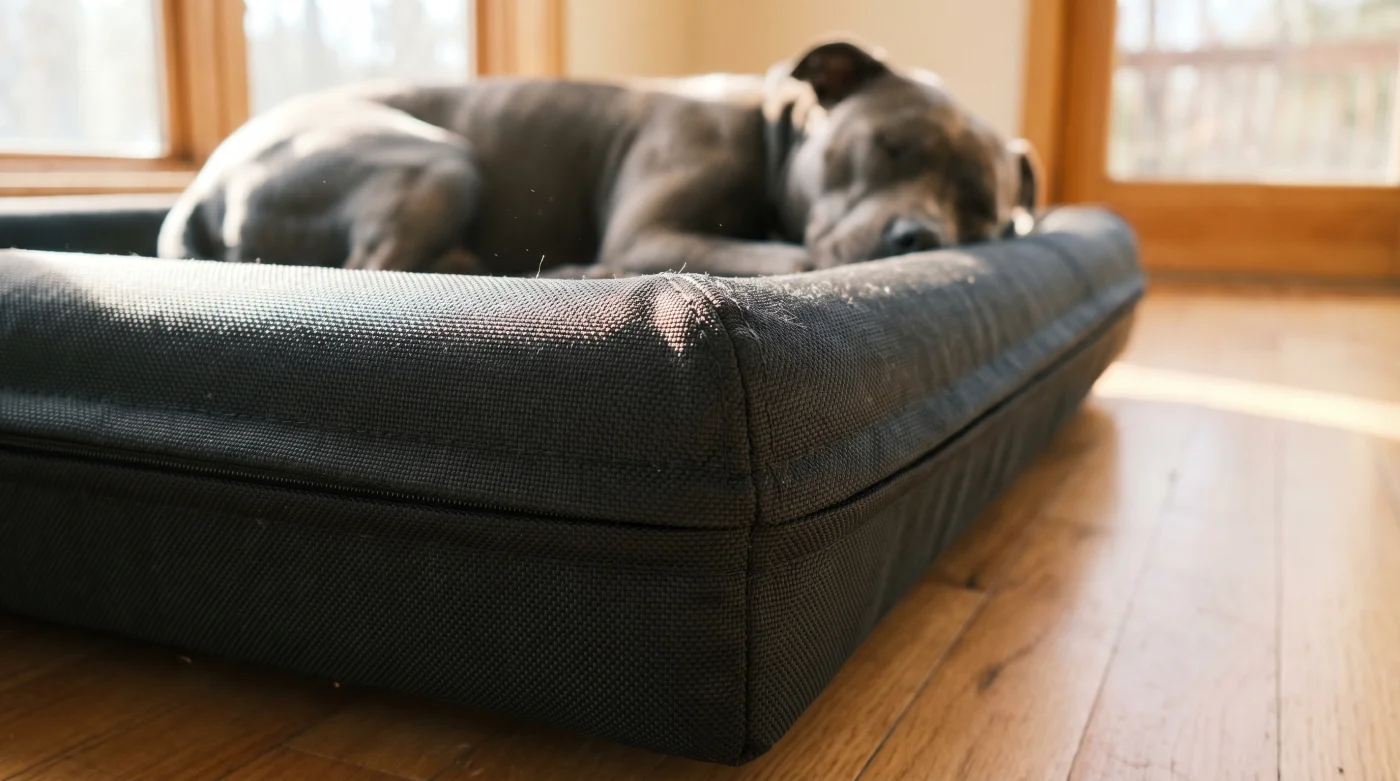
The tearing sound starts low, like thick paper ripping slowly in the next room. You walk into the living room, coffee mug in hand, to find a miniature snowstorm. White polyester batting drifts lazily across the hardwood floor, clinging to the baseboards and catching in the rug. In the center of the carnage sits your dog, panting lightly, looking remarkably proud of the hollowed-out shell that used to be a premium, supposedly chew-proof dog bed. The tags claimed it was military-grade. Your living room suggests otherwise.
The familiar pit of frustration settles in your stomach as you grab a trash bag. You bought the thickest, stiffest material you could find at the big-box pet store, trusting the rugged green fabric to withstand those powerful jaws. You spent time reading reviews, researching thread counts, and investing in their comfort. It lasted exactly forty-two minutes.
We are sold on the idea that weight and stiffness naturally equal durability. Marketing labels boast about double-stitched canvas, tightly bound denim, and industrial-grade padding, assuming that if a fabric is hard for a human hand to rip, it must be impossible for an animal to destroy. But when you are dealing with a terrier’s bite force, thickness means absolutely nothing if the texture is wrong.
The illusion of sheer weight is a trap many owners fall into when trying to solve this problem. A thick material is just a thicker chew toy if the surface geometry allows a dog to gain leverage. To actually stop a heavy chewer, you have to stop thinking about armor and start thinking about friction.
The Canvas Trap and the Friction Principle
We have been conditioned to believe that rough, stiff materials like waxed canvas are the pinnacle of toughness. Think of heavy work jackets, rugged backpacks, or old canvas military tents. But a dog’s mouth operates differently than a branch scraping against your pant leg on a hiking trail. Canvas provides an incredible amount of friction. Those tiny, fibrous ridges give a canine incisor something to catch, grip, and pull until the structural fibers snap under pressure.
Denying them a starting point changes the entire equation of canine destruction. It is not about how thick the bed’s padding is; it is about how slippery the surface becomes when a wet nose and teeth try to get a solid grip. This is where ballistic nylon shifts the paradigm. Originally developed for flak jackets to deflect shrapnel during combat, the material is notoriously slick. A dog’s teeth simply slide off the tightly woven synthetic fibers, finding absolutely no purchase to begin the tearing process.
Marcus Vance, a 42-year-old tactical K9 handler from Ohio, learned this lesson after replacing countless beds for his energetic Belgian Malinois. His garage used to look like a graveyard of shredded memory foam and torn green canvas. He spent hundreds of dollars trying to out-muscle his dogs with thicker materials before realizing he was approaching the problem backwards.
Dogs are opportunistic puzzle solvers, Marcus explains from his training facility. “They don’t open their mouths flat against a wide mattress and just bite down. They search for a flap, an exposed zipper, a loose tag, or a folded corner. Once they get a fraction of an inch of thread between their front teeth, they use their neck muscles to pull. The structural integrity is gone in seconds.” His working dogs now sleep exclusively on ballistic nylon beds constructed with entirely hidden zippers. By tucking the hardware under a sealed fabric tunnel, the bed presents a continuous, frustratingly smooth surface. They sniff it, mouth it once, find nothing to grab, and simply lie down.
The Testing Floor: Grading the Heavyweights
To understand what actually works in a normal residential setting, we put five highly rated heavy-duty beds into an enclosed sunroom with a determined fifty-pound Pitbull mix named Buster. We left him alone with each bed for three days, monitoring the interaction and the ensuing destruction via a hidden camera mounted in the corner.
The results shattered standard expectations across the board, proving that marketing claims rarely match up to the raw reality of canine biomechanics.
For the Digger (Heavy Canvas)
The traditional heavy canvas bed lasted roughly three days before succumbing. While it expertly resisted Buster’s nails as he aggressively dug in circles to make a comfortable nest, it completely failed the moment he decided to chew the piped edging. The rough texture allowed his molars to grip the decorative trim, and he systematically unzipped the seam with his teeth, scattering foam across the floor.
For the Comfort Seeker (Cordura Blends)
A softer, textured cordura alternative held up decently well against casual scratching and offered a much quieter sleeping surface when Buster circled. However, the exposed metal zipper on the side became an instant target for his boredom. Once the zipper derailed under the direct pressure of his chewing, the plush memory foam core was exposed and promptly gutted in a matter of minutes.
For the Heavy Chewer (Ballistic Nylon)
The ballistic nylon bed was the undisputed survivor of the three-day trial. The slick synthetic fibers offered zero friction for his teeth, causing his jaws to simply slide off the fabric. More importantly, the zipper was stitched deeply into the underside and completely covered by a thick Velcro flap. Without a seam, a corner, or a zipper pull to target, Buster spent ten frustrating minutes trying to find an edge, sighed heavily, and finally went to sleep.
Deploying the Defense
Owning a genuinely chew-resistant bed requires a bit of mechanical sympathy from the owner. You cannot simply pull it out of the shipping box, throw it in the middle of the kitchen floor, and hope for the best results.
Setting up your dog’s space demands a few mindful, minimalist actions to ensure the high-tech materials perform exactly as they were designed to.
- Locate the seam vulnerability: Always orient the bed so the zipper flap faces the floor or is wedged firmly against a solid wall. If your dog cannot physically see or feel the closure, they cannot obsess over trying to open it.
- Wash with restraint: Ballistic nylon relies entirely on its slick, water-repellent outer finish to deflect teeth. If washed on hot water cycles or aggressively machine-dried, those synthetic fibers degrade and lose their protective slip. Use cold water, mild detergent, and always let the cover air dry completely.
- Address the underlying boredom: A tough bed is a passive defense mechanism, not an active babysitter. Remember that destructive chewing is often a glaring symptom of under-stimulation. Redirect that pent-up energy by keeping a frozen marrow bone or a dense rubber chew toy resting on the bed.
The Quiet Living Room
There is a specific kind of anxiety that comes with living alongside a heavy chewer. It is the constant need to pause your television, mute your phone, and peek around the hallway corner when the house gets a little too quiet, mentally bracing yourself for yet another massive mess to clean up.
Restoring peace to your home happens the exact moment you stop viewing your dog as a destructive force and start actively outsmarting their natural mechanics. When you provide them with gear that quietly deflects their jaws rather than challenging them to a frustrating tug-of-war, the entire household dynamic shifts.
You no longer have to treat your living room like a sterile, high-security zone. The evening hours finally become a relaxing time to sit back on the couch, sip your coffee, and just listen to the rhythmic, heavy breathing of a sleeping dog, completely free from the sickening sound of tearing fabric.
“Durability isn’t about making something harder; it is about giving the dog absolutely nothing to hold onto.” — Marcus Vance
| Key Point | Detail | Added Value for the Reader |
|---|---|---|
| The Canvas Myth | Rough fibers provide grip for canine teeth. | Saves you money by avoiding thick but easily shredded materials. |
| Ballistic Nylon | Slick, synthetic weave that deflects bites. | Ensures the bed survives the initial gnawing phase without tearing. |
| Hidden Hardware | Zippers tucked securely under a Velcro base flap. | Removes the visual and tactile triggers that start destructive behavior. |
Common Questions Answered
Are ballistic dog beds uncomfortable because they are so stiff?
They start out slightly rigid, similar to a new piece of outdoor furniture, but they soften up with body heat while maintaining their slick protective surface.How do I clean a bed that repels liquid?
Wipe down daily messes with a damp rag. For deeper cleans, remove the cover, wash it in cold water, and always air dry to protect the synthetic weave.My dog digs constantly before lying down. Will this hold up?
Yes. The tight weave of ballistic nylon is highly resistant to scratching and nesting behaviors, preventing dog nails from catching and pulling threads.What if my dog still manages to chew a hole in it?
If a puncture occurs, the rip-stop nature of the nylon prevents it from running or tearing further, buying you time to patch it before the foam is compromised.Is there any dog bed that is truly 100% chew-proof?
No fabric is entirely immune to a dedicated dog left alone for hours, but removing grip and hiding seams makes it frustrating enough that most dogs simply give up.