The afternoon sun cuts across your living room floor, dusting the rug in quiet gold. You are mid-sip of coffee, the house settling into a rare, afternoon stillness. Your dog is curled on the sofa, breathing softly in deep sleep, their paws twitching occasionally. Then, the blue ring of the doorbell camera spins on the porch, followed by the sharp, digital chime echoing from your phone, your smart watch, and the hallway speaker.
Instantly, the peace shatters. Paws scramble frantically across the hardwood, claws slipping in a desperate rush toward the front entrance. The barking starts before they even reach the foyer—a resonant, chest-deep alarm that rattles the picture frames. Your instinct, honed by months of frustration, is to raise your voice, to shout over the chaotic noise in a futile attempt to demand quiet.
We are taught that loud corrections establish authority, that matching a dog’s intensity is the only practical way to break their fixation on the perceived intruder outside. You might step toward them, clapping your hands or pulling their collar, hoping sheer volume will act as an immediate off switch. It feels like a battle of wills played out on a welcome mat.
But watching a professional handle a reactive dog reveals a completely different rhythm. They do not yell, and they do not pull on collars. Instead, they command the space with silence, turning what feels like a stressful confrontation into a seamless, quiet redirection that honors the dog’s instincts.
The Gravity of Silence
Think of your dog’s bark not as a sign of blatant disobedience, but as a biological fire alarm. When that digital chime rings, their genetics tell them the perimeter of the den has been breached. If you rush into the hallway yelling, you are not turning off the alarm; you are simply acting as a second, louder siren. You are confirming that there is, indeed, something to panic about on the porch.
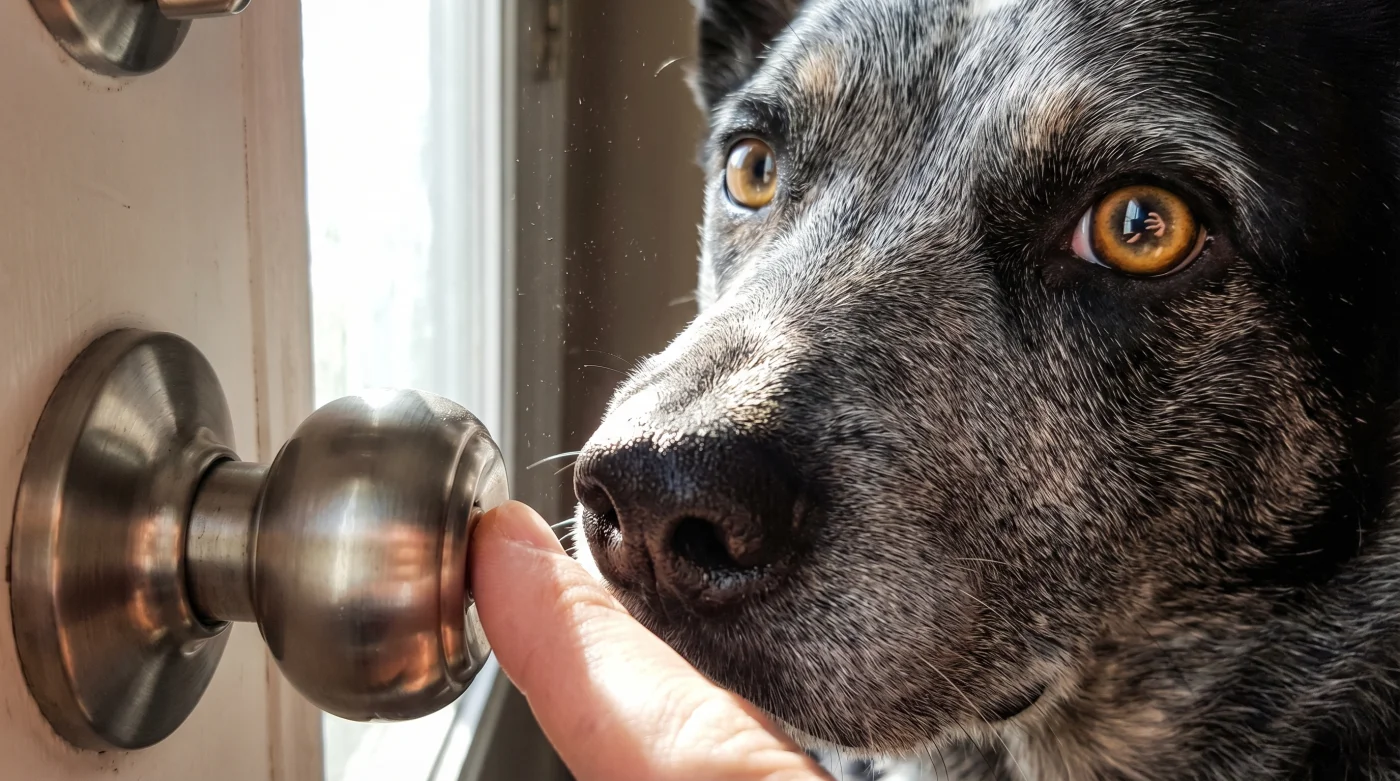
The alternative is to thoughtfully hijack that intense focus. The secret lies in a subtle physical cue that triggers a natural calming reflex. By moving slowly to the door, placing your body between your dog and the wood, and laying a flat, silent hand against the doorknob, you change the entire narrative. You are physically claiming the threshold without uttering a single syllable.
That hyper-vigilance your dog displays—the very trait that drives you crazy during a delivery—is actually a massive evolutionary advantage. Because they are so highly attuned to the environment, they immediately notice when the leader of the house physically touches the contested boundary and completely relaxes. Your silent touch tells their nervous system that the threat has been evaluated by management and safely dismissed.
Sarah Jenkins, a 42-year-old canine behaviorist from Ohio, discovered this after a decade working as a neighborhood postal carrier. She watched thousands of well-meaning owners fight losing verbal battles at their front doors. She realized the dogs only surrendered their guard duties when the owner physically interacted with the door while maintaining a dropped, completely relaxed posture. The owners who quietly pressed a flat hand to the deadbolt and took a slow breath saw their dogs physically deflate, stepping back to let the human handle the visitor.
Adjusting for the Motive
Not all dogs rush the door for the exact same reason. Recognizing the subtle nuance in their panic allows you to tailor this physical intervention perfectly to their specific psychological needs.
For the Territorial Defender: This dog has a rigid stance, hard eyes, and a deep, rhythmic bark. They genuinely believe they are the sole protector of the property. When you step between them and the door, do not look down at them. Face the door squarely. Your hand on the brass knob must be firm and deliberate, showing them you have officially assumed the watch.
For the Anxious Pacer: This is the dog that barks wildly but constantly looks back over their shoulder at you, unsure of what to do next. They do not actually want the heavy responsibility of guarding, but instinct demands they react. As you touch the cold doorknob, let out a long, audible sigh. The sound of your slow exhale acts as a brilliant pressure release valve for their pent-up anxiety.
For the Over-Eager Greeter: This dog barks out of sheer excitement, whining and wagging furiously at the prospect of a new friend. They need a physical boundary more than a psychological one. Claiming the doorknob still works beautifully, but you may need to gently step backward into their space until they offer a sitting position. Do not turn the handle until their rear physically touches the floor.
Executing the Three-Second Door Guard
The execution of this technique requires deliberate mindfulness and a complete absence of human frustration. You are communicating exclusively through body heat, relaxed posture, and deliberate pacing. The moment the camera chimes, resist the urge to react sharply.
Here is your Tactical Toolkit for the intervention:
- The Approach: Walk to the door at a measured, casual pace. Do not run or stomp your feet.
- The Positioning: Step smoothly between the barking dog and the door. Your back should be to the dog.
- The Contact: Place your bare palm completely flat against the doorknob or the deadbolt housing.
- The Three Seconds: Hold your hand there for three full seconds while consciously dropping your shoulders. Exhale slowly.
- The Release: Once the barking stops and the dog steps back, walk away from the door without saying a single word.
This exact sequence works wonders because it requires zero physical conflict. You are removing the verbal friction entirely and replacing it with undeniable physical ownership of the contested space.
Reclaiming the Threshold
A genuinely quiet home is not born from constant discipline and harsh corrections; it is cultivated through clear, unspoken agreements. When you stop fighting your dog’s hardwired instincts and start speaking their physical language, the daily tension simply dissolves.
Mastering this simple threshold interaction does much more than just save your ears from a booming bark. It profoundly shifts the entire dynamic of your living space. You become a steady, grounded presence, and your dog finally gets to retire from the stressful job of perimeter security. They realize they can leave the heavy lifting to you, allowing them to retreat to the sofa and simply rest.
Silence is the most authoritative sound you can make when a dog’s natural instincts are shouting.
| Key Point | Detail | Added Value for the Reader |
|---|---|---|
| The Standard Reaction | Shouting verbal commands over a ringing smart doorbell. | Helps you recognize exactly why past training attempts only added to the daily chaos. |
| The Silent Intercept | Placing a flat, silent palm on the doorknob for three seconds. | Gives you a practical, zero-conflict method to immediately trigger a biological calming reflex. |
| Threshold Ownership | Stepping squarely between your dog and the entrance. | Shifts the heavy security burden off your dog’s shoulders, massively reducing their baseline anxiety. |
Frequently Asked Questions
What if my dog tries to push past me at the door?
Use your legs to gently claim the physical space. Do not kick or shove; simply widen your stance and shuffle backward until they naturally yield the boundary.
Does this trick work if the visitor is actually knocking?
Yes. The trigger is the unexpected noise at the boundary. Your flat hand on the door signals that you are personally handling whatever is on the other side.
Why do I have to wait exactly three seconds?
Three seconds is typically how long it takes for a canine nervous system to register a sudden change in your physical posture and mirror your relaxation.
Should I give them a treat after they stop barking?
Avoid treats immediately after the silence. You want the true reward to be the natural relief of tension, not food, which might accidentally spike their excitement all over again.
What if I am not home when the camera detects motion?
If you use the two-way audio feature on your app, speak in a low, slow, calming tone. A sharp, high-pitched voice crackling through a tiny speaker will only validate their alarm.